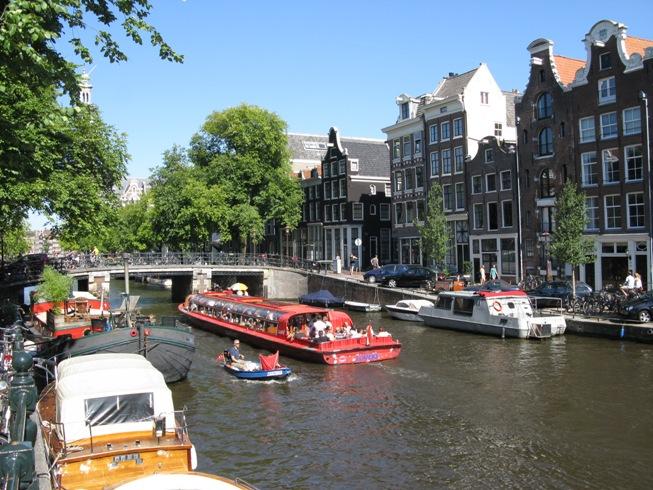
Water has
always been an important element and a crucial factor in shaping the economy
and the way of life of the Dutch. No wonder that the Golden Age era (the 17th
century, to be more precise) enabled Amsterdam to take full advantage of all
the technological advancement of the time. As a result, what was initially
designed as an efficient system of land irrigation and water drainage has
become a beautiful landmark blooming with fantastic historic sights, as well as
a range of ever-surprising contemporary attractions. After all, UNESCO can’t be
wrong with entering the Canal Ring (or the Grachtengordel, as the Dutch say)
into their World Heritage List in 2010. No other city can boast anything
similar, so let us take you on a brief textual tour and highlight the most
important features of this amazing wonder.
The Canals
To make the
most of your trip along the charming alleys stretching along the canals you
might start your journey either from the east, from the area of Weesperbuurt en
Plantage – the area that comprises the fantastic Artis Zoo, the absolutely stimulating
green Hortus Botanicus botanic garden and is bordered with the central vein of
Amsterdam – the river of Amstel with its beautiful riverbanks. This part of the
city is not the original part of the Grachtengordel, but as Amsterdam grew, it
has became gradually adapted to form an extension of the traditional section
and now is a home to the aforesaid attractions, as well as some other great
places, including the Van Gogh Museum or the Magere Brug café, where you can stop
by, have a nice cup of coffee or tea and then cross the river to explore the
wonders of the Canal Belt. Alternatively, you might start your sightseeing from
the default center of the city, the Amsterdam Centraal – just like we did – and
before heading west in the direction of Singel, you might find it interesting
to spare a minute at Damrak – a partially filled in canal in the city centre
(with the majestic Oude Kerk right behind it and the flamboyant Sexmuseum right
next to it), boasting a great surrounding of lines of traditional Dutch
tenement, plus an additional attraction in the form of the so-called ‘dancing
houses’ – an optical illusion of movement of the houses lined right at the edge
of the canal, named ‘dancing’ as with time, their structures became slightly
skewed and misaligned, creating a really exciting view.
Anyway,
once you arrive to Amsterdam and have the first impression already behind you,
we suggest that you follow the path we chose; the easiest way to get to the
western starting section of the Grachtengordel and not to get lost in the maze
of tiny charming alleys is to follow Prins Hendrikkade street (and before that,
visit the Dwaze zanken for a cup of coffee) to the west and once it intersects
with Singel, you’re at the right place to start your trip which we hope will be
as exciting as ours.
The Canal
Belt is formed by four main ‘routes’ that stretch along the whole belt, from
the north-west to the south-east. They are Prinsengracht (‘Prince’s Canal’,
featuring Noorderkerk, Homomonument, Westerkerk and Anne Frank House),
Keizersgracht (‘Emperor’s Canal’, the widest of the three), Herengracht (‘Patricians’
Canal’ or ‘Lords’ Canal’, with its Golden Bend – the most fashionable part of
it, featuring many double wide mansions and inner gardens) and Singel (in the
past used as a city moat marking the border of the city). Of course, you’ll
find a good deal of many other smaller alleys lying at right angle to the main
ones, but let’s focus on the latter as they will guide you along the whole
amazing length of this remarkable area.
Also,
depending on the season you come to Amsterdam, we’ve learned that there are
some great events held in the lovely setting of the canals. For instance, at
the end of April you have the Queen’s Day (from now on changed to King’s Day,
actually) and in August there is the annual Gay Pride celebration with
decorated barges, colorful clothes and loud music. In the same month you can
also see the Grachtenfestival with orchestras, soloists and other more
‘classical’ performers delivering their talents to the onlookers gathering in
the area. Still, if you come in Winter you might get the chance to skate on ice
on the very surface of the canals. This, of course, depends on the temperature,
but the winter of 2012 allowed even to organize the ‘Keizersrace’ – a race that
hasn’t been organized for the last 15 years!
It is not
easy to underline all the main points of interest of the area – as there are
simply too many of them. What we did was to move along in a slightly zigzaggish
manner – from the right to the left under a small angle and the other way back.
This way we could admire both sides of the belt and still not miss on the major
attractions that are there to see. Starting off from the edge of Singel, we
went for a great dinner in Het West-Indisch Hut right next to the small, yet
somehow enchanting Herenmarkt and then moved south along Singel. Passing by the
Multatuli Museum, we switched sides and passed the Huis Met de Hoofden – a
major example of Dutch Renaissance style featuring an ornamental façade with
lion masks, vases, obelisks and the heads of Apollo, Diana, Ceres, Bacchus,
Minerva and Mars. Actually, you will find many such amazing buildings lining
each of the canals, some older, some newer, but all fitting perfectly in this
fantastic setting.
Moving
further to the south, you’ll reach the world-known Anne Frank House, right next
to the massive Westerkerk. This astonishing house-museum, devoted to a notable
victim of the Holocaust, one of the must-sees when you’re in Amsterdam and when
strolling along the Canal Belt, the list of all the highlights could go on and
on, so let us just give you a brief summary and recommend a few places that you
definitely have to see while you’re there. One more thing – don’t be surprised
by the sight of actual houseboats docking on the water – most of them are
really modern and used, e.g. to provide accommodation for tourists (also
available in Short Stay Group’s offer) and draw heavily on the local tradition
of rafting and if you follow Prinsengracht you’ll surely reach the Houseboat
Museum, so this is another point on your sightseeing schedule.
The thing
that we found quite unusual was how close to each other were all the bricked houses
lining the canals. Still, it didn’t fell ‘claustrophobic’ at all – on the
contrary, it provided a sense of cosiness and an intimate atmosphere not to be
found in any other city of modern Europe. Add to this the plenty of fine cafés,
coffee shops, bars, smaller and bigger galleries, markets of variety (selling
books, peculiarities, but also food, clothes and daily use items) and fancy
boutiques, and you have a recipe for a perfect time.
We surely haven’t visited everything that’s out
there to see, but we managed to have a peek inside the Huis Marseille on
Keizersgracht – a fantastic international photography venue, located somewhere
close to where the Canal Belt bends eastwards, and to visit a couple of
absolutely amazing clubs on Rembrandtplein – the place which, quite sadly,
marks the eastern end of the original part of Grachtengordel. Still, lots of
other sights await to be discovered on every single canal street and the smooth
blend of densely-planted trees with traditional Dutch architecture makes it a
pleasure to stroll through the area. However, if you wish to change the
perspective a bit, you might as well get on a guided cruise along the canals or
rent a pedal boat and explore the vicinities by yourself. Totally worth it.
2006-2021 © AmsterdamApartamenty.pl Polityka Prywatności| Ogólne Warunki Handlowe
