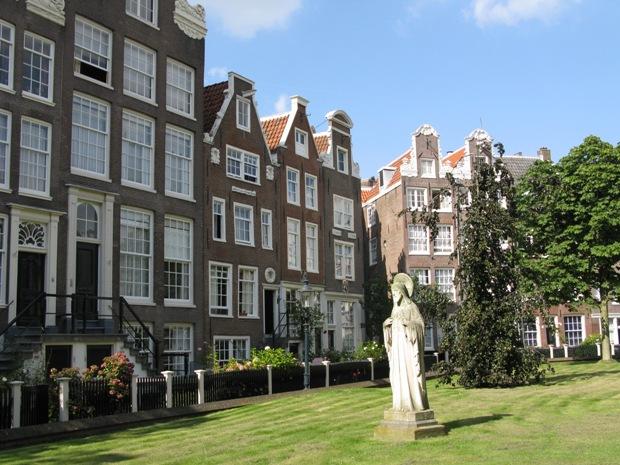
The
Begijnhof is one of those really rare sights to see, especially given the
ever-developing modern metropolitan setting of Amsterdam. It is one of the
oldest inner courts in the city – and the only remaining one, for that matter. Once
you’re there you’ll come across a range of breathtaking 14th-century
typical Dutch buildings; they are private houses in vast majority – still
occupied today, so you have to remember to respect the privacy of the residents
although the entry itself is free. Apart from that, the place is also a home to
the English Reformed Church, so you can expect to see daily masses, weddings
and baptism ceremonies taking place.
The area
Located in
the south-western section of the city center, between the lower part of the
Singel canal to the west and the area of Rokin to the east, the Begijnhof appears as something out-of-the-ordinary, bringing strong
memories of the past with its unique architecture, charming atmosphere and a
hint of mystery in the air. This picturesque court used to be once surrounded
by water in its entirety, with the only entrance available at the Begijnsteeg
(‘Beguines’ Alley’) accessible via a bridge across the Begijnensloot (‘Beguines
Ditch’). The southern entrance from the Spui is a 19th-century reconstruction
of the 17th-century addition and does not only facilitate the access
to the place, but also opens onto a lovely book and art market which is also
surrounded by lines of fantastic cafés, restaurants and boutiques, and to the
north you’ll also find the Amsterdam Museum – rich with art and history, so
you’re bound to take some advantage of many diverse attractions apart from the
obvious aesthetic charm of the Begijnhof. Another interesting fact about this
amazing spot is that as a medieval construction, it is a meter below the rest
of the old city center, enhancing the special mood this place exudes.
The history
Founded in
the 14th century, the Begijnhof has always had a special meaning to
the Venice of the North. The name of the court comes from the Beguines and
Beghards – lay Christian religious orders who devoted their lives to help those
in need, active mostly in Germany and neighboring countries (including the
Netherlands, obviously) in the period of 13th to 16th
century; the members of the congregation did not accept formal religious vows and
lived in semi-monastic communities – just like the Begijnhof, the ‘court of
Beguines’, although they declined from their ways by the 16th
century. Another notable fact is that the order of Beguines consisted of single
women only – mostly single by choice, but also widows, and although there are
no Beguines left any more (the last of them passed away in 1971), the rules
allow only such women to live here and some still do, in fact, so if you enter
this magical place, try not to exaggerate with photo-taking so as not to
disturb the rhythm of life of those local inhabitants.
The place
What makes
this place so special is that it has managed to remain a peaceful oasis in the
rapidly-expanding city like Amsterdam throughout all these years. A true
Shangri La for all those seeking for a moment of tranquility inside the busy
metropolis, it boasts a calm, slightly mysterious atmosphere and a beautiful
original setting, and all this behind a mere, ordinary door serving as the
entrance; think a bit ‘The Secret Garden’ by Frances Hodgson Burnett and you’ll
get the idea.
Behind the
‘gates’ you’ll find a belt of 47 traditional Dutch town houses; their original
facades had to be changed and renovated in most cases, but the original
structure has been kept without unnecessary interference. The buildings are
really tall and reflect the architectonic trends of the time – the fondness of
large windows and soaring rooftops seems to describe it best. Each of the
houses possesses some distinctive features, yet 18 of them still enjoy a very
characteristic original Gothic wooden framework.
While all
of the finely-preserved buildings found within the enchanted walls of the Begijnhof
are of big historical importance and tell a lot of the Dutch society of the
time, some of them have moved a bit to the foreground with their qualities,
like the black-walled Het Houten Huis (translated simply as the ‘Wooden House’)
or the remarkable structure of the English Church (Engelse Kerk). The former is
actually the oldest house in Amsterdam, with the records mentioning the year
1420 as the time of its construction, while the latter, found in the southern
part of this ‘natural museum’, functions as a landmark with its soaring spire
and dates back also to the early 15th century, belonging originally
to the Beguines but handed over to the Protestants in 1578. Four pulpit panels
found inside the church were designed by Piet Mondrian – a famous Dutch
painter, especially significant for Neo-Plasticism and an important contributor
to the De Stijl art movement. The church itself as an institution is still
active and delivers all the usual masses and ceremonies on a regular basis.
Another
merit ascribed to the Begijnhof is that in the 17th century it
became a home to one of the few ‘resorts’ for the Catholics. In 1671 it had one
of its private houses transformed by Philip Vingboons (a renowned architect of
the time) into a ‘schuilkerk’ – a secret Catholic church (also known as the
Begijnhof Chapel), named after Saints John and Ursula – the patron saints of
the court of Begijnhof.
Apart from
lots of other stories each building has to ‘say’, the court is also a great
place to plunge into reflection in the surrounding of impeccable greenery of
the lawn and trees rustling quietly in the wind. You’ll also be able to see an
intriguing original water pump and a statue of a Beguine. This Dutch ‘Silent
Hill’ is also credited with one another significant and a bit ‘eerie’ quality –
the strong affiliation to miracles said to have occurred in the past, with one
notable example of the Eucharistic Miracle of Amsterdam from 1345, veiled with
a mist of mystery.
If you’re
looking for some peace and quiet, a moment for introspection, reflection or an
occasion to ponder on the less-earthly matters, the Begijnhof is the perfect
place to go to. Enveloped by a curtain of secret and unusual tranquility, this
wonderful court gives you a deeper insight into a very specific bit of the
city’s history, but also provides you with great opportunity to discover the
precious qualities of Amsterdam’s architecture of the past. The Begijnhof is
open every day between 9 a.m. to 5 p.m., but once you decide to visit the
place, do bear in mind that it is still inhabited, so try to make your visit
in-line with the overall mood of the spot – quiet and focused on enriching your
inner experience.
Civic Guards Gallery
Another
great addition to this solemn place is the direct access to the Schuttersgalerij,
or the Civic Guards Gallery, constituting a section of Amsterdam Historical
Museum’s exhibition. It is a remarkable gallery of old portrait paintings
depicting many distinguished citizens of Amsterdam. If you’re strolling through
the courtyard of the Begijnhof, follow it until you see a huge glass, take left
and head right to the Gedempte Begijnesloot dead-end alley. The entrance to
this charming gallery is there – free of charge.
2006-2021 © AmsterdamApartamenty.pl Polityka Prywatności| Ogólne Warunki Handlowe
