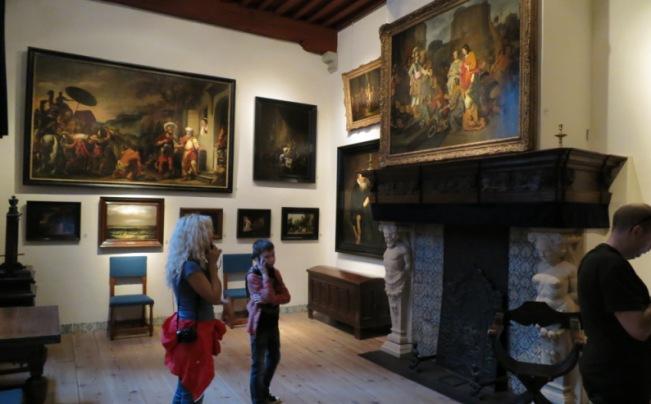
Step back into history
and experience how Rembrandt and 17th century Amsterdam lived. See
Rembrandt’s paintings, drawings and etchings and watch how he mixed his paints
and made his etchings. Located in the old city centre this is a reconstruction
of the famous Dutch painters house and not the place to see his masterpieces.
All in all it makes an interesting and educational outing for all ages.
Go back in time with Rembrandt
It’s not just a museum it’s a reconstruction of
this famous artists home, his private space and a step back into history; all
set in a 17th century house. Experience the conditions in which one
of Holland’s most notable people lived and worked in. It’s one thing walking
through a big gallery-like museum admiring artful masterpieces connoting fame
and fortune but another to witness the actual surroundings in which these
famous artists worked and lived in, it’s so much more eye opening.
When I decided to visit the Rembrandt House
Museum I didn’t know much about it and I did think I’d see some of his most
famous work but that’s not what this museum is about. I was a tad disappointed
about that but the visit was well worth it in the end. We were able to go back
in time and live in 17th century Amsterdam and in Rembrandt’s house.
This museum makes an ideal outing for fans of
Rembrandt, those interested in the history of art or even just history in
general. One of the most interesting parts of the visit was the demonstrations
on how Rembrandt made his etchings and prepared his paint. Rembrandt enjoyed
etching and so had his own press room in the house which you can see on the top
floor along with a collection of his original etchings. Demonstrations are on
every day in Rembrandt’s printing room and will tell you everything about the
etching technique, the printing process and answer any questions about graphic
art. The print preparation demonstrations are in Rembrandt’s studio every day
and show you how paint was made in Rembrandt’s time as you watch the pigments
and oil turn into coloured paints right before your eyes.
Located in the old city centre in the
Nieuwmarkt and Lastage district, the museum is a short walk away from many of
the other famed city attractions and areas such as China Town, the Red Light
District, Dam Square, Rembrandt Square and Artis Zoo. Rembrandt lived and
worked in this then new house from 1639 to 1658. As you stand in front of it
you will notice the modern annex to the left which is a new addition to the
museum.
On entrance you are given an audio guide which
is very informative throughout the tour of the house. The museum is very
educational teaching you how Rembrandt affected life in Amsterdam and vice
versa, and giving you an insight into art in that period. You also get to learn
about his history and his financial hardships. The paintings have descriptions
so that you can learn more about each one and the tour explains painting
techniques. In the attic are a studio and various private collections of
oddities. There is a special discovery trail tour for children during which
they can learn to look at details in the room, think about aspects of 17th
century life in the Netherlands and learn to look at works of art. In addition
there is also an audio tour specially for children which is available in
different languages including English, French, German, Italian, Spanish and
Russian.
Alongside being an artist Rembrandt was also an
art dealer and the front room functioned as a gallery where he did his
business. It was interesting to see his house and some of the objects he used
as subjects in his paintings and drawings. In total during his time he produced
around three hundred paintings, three hundred etchings and two thousand
drawings. He also used the people in his life as subjects; his wife, son and
mistresses.
The house
The Rembrandt House in that time was in a new and
expensive neighbourhood which Rembrandt, although quite established by then,
could not afford entirely so his mortgage agreement included instalment
payments. Having not met all the payments forced him into great debt and
finally into bankruptcy. All the belongings were sold and the house was
occupied by other tenants while Rembrandt moved into a smaller place by the
Rozengracht canal. Eventually the City of Amsterdam bought the building in the
20th century and shortly after handed it to the Stitching
Rembrandthuis foundation. The museum didn’t resemble Rembrandt’s house until 1999.
Inventories and Rembrandt’s drawings and etchings were all used to reconstruct the
rooms. Now the museum is even bigger and includes the house next door.
One of the quirkiest things we got to learn was
why Dutch box beds were short: not because people were shorter but because they
believed that you should sleep propped up by pillows as lying flat could cause
bad consequences such as death through blood rushing to your head. There wasn’t
anything that we didn’t like; it was just really interesting to visit a museum
that’s so intimate and informative, not just about the painter but about life
in the 17th century in relation to art
. But remember, if you only want to see his masterpieces such as
The Night Watch, The Jewish Bride and
The Syndics then go to the Rijksmuseum! The
Rembrandt House Museum however does have many great pieces of art such as
Portrait of Jan Six who was to become
mayor of Amsterdam in his later years.
Events at Rembrandt’s
House
The museum can be used for events such as
dinners, lectures or presentations. The museum areas are accessible for guests
with or without a guide while the event itself takes place in the auditorium
which is in the new wing of the museum. Events can be booked for any day of the
week and can run between 5.30 PM to 11 PM. Catering is also supplied at extra
cost.
Just a couple of tips
·
If
you book your tickets online through the Rembrandt House Museum site the
entrance fee is cheaper by 2, 50 Euros for adults and 1 Euro for children.
·
Amsterdam
is filled with many museums and if you plan on visiting at least four during
your stay then it may prove more cost effective to purchase a Museum Card which
allows free or discounted entry but you should always check that this includes
the museums that you want to visit before you buy.
Opening hours and fees
The museum is open daily from 10 AM to 6 PM.
Closed on New Year’s Day, Queen’s Day (30 April) and Christmas Day.
Adults: 12, 50 Euros (10, 00 Euros if booked
online)
Children age 6 to 17: 4, 00 Euros (3, 00 Euros
if booked online)
Entrance is free to those with a Museum Card or
the I Amsterdam City Card
Address
Jodenbreestraat 4, 1011 NK
Amsterdam
0031 20 520
0400
www.rembrandthuis.nl
Getting there
About fifteen minutes on foot from
our apartments around Dam Square and even quicker from our short stay apartments
in the Rembrandt Square and Red Light District areas.
Nearest Tram station is Waterlooplein, lines 9
and 14.
2006-2021 © AmsterdamApartamenty.pl Polityka Prywatności| Ogólne Warunki Handlowe
